Keeping track of bird sightings helps you notice patterns in bird behavior and migration over time. A bird journal lets you record what species you see, where you spotted them, and other details about each bird sighting. Plus, writing down your observations makes birdwatching more interesting and helps you become better at identifying different species.
We’ve noticed that bird journals vary from basic notebooks to full-on dedicated logs with designated fields for essential details. A dedicated bird journal prompts you for the information most important to birders, such as date, location, weather, and bird characteristics. These journals often include extras like quick-reference pages for common species and ample space for sketches.
The most important things to consider when choosing a bird journal are the layout style, paper quality, and size. Some journals use structured templates with fill-in-the-blank fields, while others offer open pages for free-form notes. The paper needs to handle pencil or pen without coming through. This is especially true if you plan to add sketches or notes in a range of weather conditions.
Size matters too because you need something portable enough to carry on hikes but large enough to write comfortably. We researched and evaluated multiple bird journals to find the ones that make recording your sightings simple and enjoyable.
Best Bird Journals for Beginners or Ornithologists
We’ve put together a good list of the top bird journals. These will help you track and remember your birdwatching adventures. Our picks include options for beginners and experienced birders. Some have features like guided prompts and sketching space. While others have species checklists.
LifeList Notebooks
We can’t talk about bird journals without mentioning this indie company that creates one-of-a-kind birding field notebooks. Great for gift-giving and a very unique gift for any person who loves birds!!! If you are looking for a birding journal gift that is one-of-a-kind, I would not hesitate on purchasing this.
journal, one thing I appreciate is the thought that goes into both the design and the materials. The journals are printed in the United States using paper sourced from companies that place a strong emphasis on sustainability. In particular, the cover stock comes from a paper mill that has been powered by renewable hydropower for more than a century, helping reduce reliance on fossil fuels while also supporting local wildlife through conservation-minded projects.
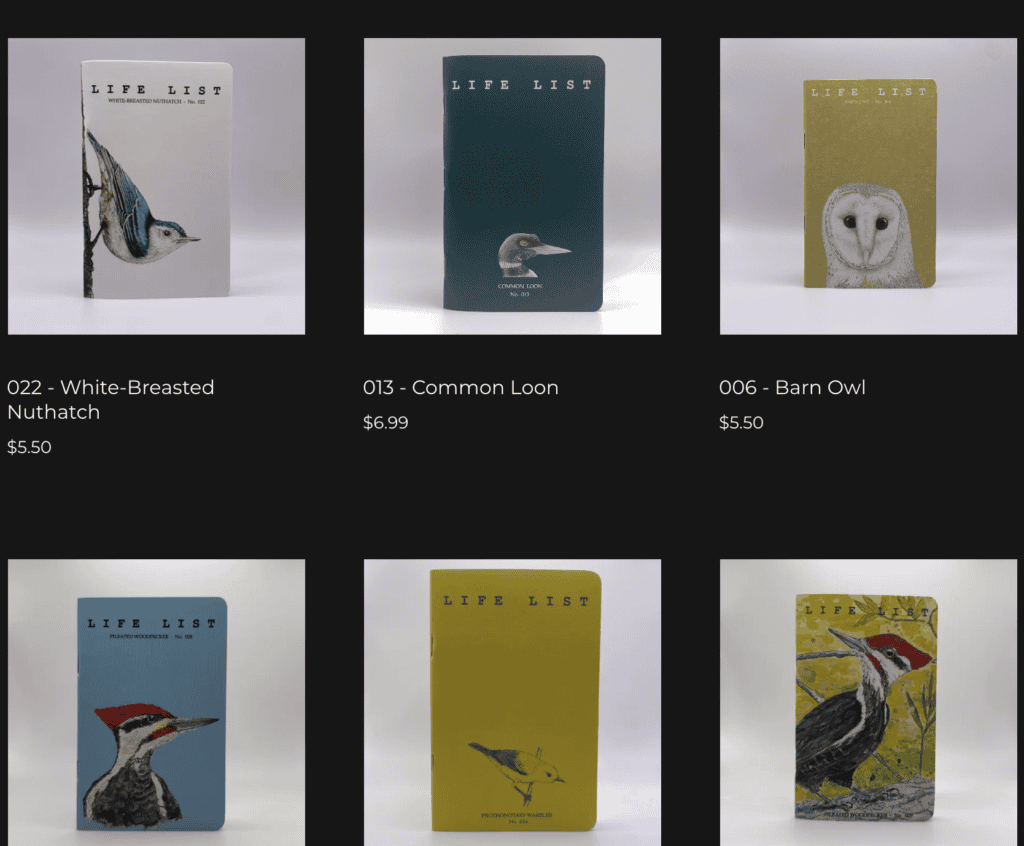
For me, what really sets these journals apart, though, is the artwork. Because each cover is designed by an artist, it feels like more than just a typical notebook. Whether you choose a species you see every day or a bird you’ve been hoping to find on your life list, the covers add a personal touch that stands out in the field.
The company also offers custom journals, so you can create a one-of-a-kind gift. You can create a notebook featuring a favorite species, a memorable “spark bird” that got you interested in birding, or even a target bird for an upcoming trip. It turns a practical field journal into something much more personal and meaningful.
OptiLiving Birding Journal – Life list
This journal works great if you want a simple way to track birds without paying too much for fancy features. This is good for beginner birders who want to start tracking which birds they spot while walking or watching from their windows. Many birders start by just observing the birds out thier windows!

- LIFE LIST: List new species as you see them, with space for species name, location and date (120 entries over 8 pages).
- DETAILED SPECIES LISTING: Write all of the details about each bird, with plenty of space for both notes and sketches (120 pages, 1 page per bird).
- CHECKLIST: Gives each bird 8 columns, so you can divide each sighting of a bird up by location, year, season, who saw it, and more (120 entries over 10 pages).
- All 3 of the above sections cross-reference one another by page number. This allows you to EASILY LOCATE EVERY MENTION OF THE SAME BIRD WITHIN THE JOURNAL, which saves you time.
- 133 total pages for 120 bird entries | A5 SIZE (8.3x5.8”) | SPIRAL BOUND - so you can effortlessly open and lie the book completely flat, allowing lots of space for easy writing.
Pros
- The spiral binding lets you fold pages back completely, so writing feels easy and natural.
- Three different tracking sections connect to each other with page numbers, so finding past entries takes no time.
- Plenty of space exists for both notes and drawings on each of the 120 bird pages.
Cons
- The price seems high for what you get compared to basic notebooks.
- Only 120 entries might not last long if you watch birds often.
- The cardboard cover feels less sturdy than we expected.
The layout helped us when we started using this journal. The life list section sits at the front, where you can quickly jot down new birds as you spot them. Each entry has spots for the species name, where you saw it, and the date.
The detailed species pages give you a full page per bird. We liked having room to write notes about behavior and sketch what we saw. The cross-referencing system connects everything, which saved us from flipping through random pages trying to find where we first logged a specific bird.
The checklist section offers eight columns per bird. We used these to track different locations and seasons when we saw the same species again. The A5 size fits in most bags without taking up too much space. At just over half a pound, it travels easily on hikes.
The spiral binding really shines when you’re out in the field. Being able to fold it back and write on a single page while standing up is awesome! Some people worry that spiral notebooks fall apart quickly, but ours held up fine after regular use. The misty blue cover looks nice but shows dirt easily if you set it on the ground.
Rite in the Rain Birder’s Journal
This compact notebook works great for recording bird sightings in any weather, though you’ll fill it up quickly if you’re a serious birder.

- WEATHERPROOF PAPER: 64 pages / 32 sheets per notebook. Sketch, fill in information, and place photos in the fill in the blank page pattern. This paper that won’t turn to mush when wet and will repel water, sweat, grease, mud, and even survive the accidental laundry mishap and more.
- WIRE-O BINDING: Tough impact-resistant Wire-O binding won't lose its shape in your backpack or book bag. Unlike a standard spiral notebook, Wire-O keeps your open pages aligned and intact.
- WRITE IN THE RAIN: When wet, use a standard #2 pencil or an all-weather pen. Standard ballpoints and permanent markers will work when paper is dry. Water-based inks will bead or wash off Rite in the Rain Paper.
- WATERPROOF NOTEBOOK COVER: Polydura material creates a tough but flexible outer shell. While birding, hiking, or outdoors, the Polydura cover material will defend your field notes from scratches and stains.
- RECYCLABILITY: Unlike synthetic waterproof paper, wood-based Rite in the Rain is completely recyclable. Please recycle Rite in the Rain as you would other office printer paper.

Pros
- The pages hold up perfectly in rain, snow, and mud without turning into mush.
- The tough yellow cover protects your notes from getting damaged in your backpack.
- Each page gives you space to sketch the bird and write down details about what you saw.
Cons
- You only get 32 pages for bird entries, which fills up fast.
- The 4.625 by 7-inch size feels smaller than expected when you first open it.
- The price seems high for the number of pages you get.
We took this journal on a rainy morning hike and watched it perform like a champ. Our regular notebook would have been ruined, but we wrote clear notes with a pencil while water dripped right off the pages. The wire binding stayed flat against a tree trunk as we sketched.
The layout works well for quick field notes. We drew a rough outline of a Downy woodpecker on the blank side . Then jotted down its black-and-white markings on the lined side. Everything stayed organized and readable even after the notebook bounced around in our bag all day.
The Polydura cover took some scratches from branches without tearing. We didn’t baby this journal at all, and it still looks presentable after weeks of use. The yellow color makes it easy to spot in a dark backpack.
The biggest letdown is how fast you’ll run through it. We logged about two weeks of regular birding before needing a new one. If you’re building a life list, plan on buying several of these journals throughout the year.
Sibley Birder’s Life List and Field Diary
We think this journal is perfect for birders who want one organized place to record their sightings and track species over time. One thing to note is that it’s better for advanced birders because of how they organize the nomenclature. The fact that it has an entire section for new birders to add to their personal life list makes this a must-have for anyone wanting to get into this hobby!

Pros
- Three different sections let us record sightings, make notes, and check off species in multiple ways.
- Well-built with a well-designed layout that works great for beginners and experienced birders
- Enough space to write details about when and where we saw each bird
Cons
- The book is not easy to navigate by name for novice birders.
- A few newer bird species added since 2024 aren’t included in the lists.
- The cover can arrive with scuffs or damage during shipping.
We’ve been using the Sibley Birder’s Life List and Field Diary to track our bird sightings for a while now. The three-section design really helps us stay organized. The first section has individual species pages where we can write down dates, locations, and observations about each bird we spot.
The checklist section is our favorite part. We can quickly tick off birds we’ve seen. It’s much easier than keeping loose papers or random notes strewn around.
This book works best when we leave it at home or in the car rather than carrying it into the field. We take a small notebook on hikes to jot down quick notes, then transfer everything to this diary later. The pages are thick, and the binding holds up well to regular use.
Some printing issues do exist. We noticed a couple of page numbers that send us to the wrong species. A few newer birds that got added to official lists in recent years aren’t in here either. But these small problems don’t really hurt how useful the journal is overall. The layout makes recording our birding adventures simple and fun.
National Geographic Birder’s Life List and Journal
This journal works well for birders who want a straightforward way to track their sightings without getting weighed down by extra details. The multiple-entry checklist in the back is a favorite among our birding group. You can actually do it year by year to see which birds you spotted in prior years.

Pros
- A nice layout with dedicated spaces for dates, locations, checklist, and personal notes about each bird sighting
- Covers most North American bird species without burdening you with descriptions
- Well-organized design that becomes easy to use once you learn the format
Cons
- Requires you to already know your birds since it doesn’t include identification descriptions
- Takes a little time to get familiar with how the pages are set up
- Might feel too simple for birders who want more detailed tracking features
We’ve been using this National Geographic journal regularly over the past few weeks. The layout gives us spots to write when and where we spotted each bird, along with room for our own observations.
The book focuses on letting us record our sightings rather than helping us identify birds. This keeps it compact and manageable. We need to know what we’re looking at before we write it down, which works fine if we already have field guides or apps for identification.
What we appreciate most is how the design stays out of our way. Once we got used to where everything goes, filling in our sightings became quick and enjoyable. But this fact is true for any of these birding jounals. Once you get used to the one you are using then filling in your sightings becomes easier.
The pages handle most North American species we encounter. We like that National Geographic kept things simple, rather than cramming in too many features that would make the journal harder to use.
The Backyard Bird Journal

We all know Amy Tan for her famous book The Joy Luck Club. But did you know that she is an avid birder? This journal works great if you want a structured space to record and sketch the birds you see while spending time outdoors. I think this book is a must for any person wanting to get into birding. Amy Tan’s love and obsession for birds shines through and is someone infectious.
Pros
- Gives you plenty of room to both write notes and draw pictures of birds
- Makes it easy to turn bird watching into a creative activity instead of just taking photos
- It has a lay-flat spine that allows you to easily document the birds
Cons
- At 208 pages, you might fill it up faster than expected if you watch birds every day.
- The binding might not hold up well if you’re rough with it outdoors.
- Some people may want more guidance on sketching techniques.
During my many park bird-watching sessions, I have gotten really into observing and this book helps with that. Did you know that quick sketches turn passive birdwatching into an active experience? It feels good to put pen to paper instead of always reaching for our phones. Birding can be an art project.
We found the size just right for carrying around the yard or taking on short nature walks. It slips into a tote bag easily and doesn’t weigh us down. The paper quality holds up to pencil and pen without much showing through.
This journal helped us connect more closely with the birds visiting my neighborhood. We noticed details we used to miss because we were focused on getting the perfect photo. For example: the differences between the Hairy and Downy woodpeckers can be seen by looking at the back of their heads!
Drawing forces us to observe wing patterns, beak shapes, and subtle color variations we’d fail to notice.
Buying Guide
When we’re looking for a bird journal, some critical features help us find the right one for our needs.
Size and Portability
The size of the journal matters a lot. If we plan to carry it on hikes or bird-watching trips, we want something compact and lightweight. A journal that fits in our backpack or pocket makes it easier to record sightings on the go.
Page Layout
Different journals offer different page layouts. Some have blank pages, while others include prompts or sections for specific information. Others have in depth checklists that allow you to populate new ones each year. We should consider which details we want to track, such as date, time, location, weather, and bird behavior.
Here’s what to look for in page layouts:
| Blank pages | Sketching and freeform notes |
| Guided prompts | Structured data collection |
| Grid or lined | Organized writing and lists |
| Mixed format | Combination of notes and drawings |
Paper Quality
The paper quality affects how we can use the journal. Thicker paper handles ink better and prevents bleed-through. If we plan to use watercolors or markers for sketches, we need heavier paper weight.
Binding and Durability
We want a journal that can handle outdoor conditions but not be so rugged and heavy. Hardcover journals protect pages better than softcover ones, but they may be more clunky to bring to the park. To note: Spiral binding allows the notebook to lie flat, making writing easier in the field.
Additional Features
Some journals include extras like reference guides, bird checklists, or space for photos. These can be helpful, but we should think about whether we’ll actually use them.