
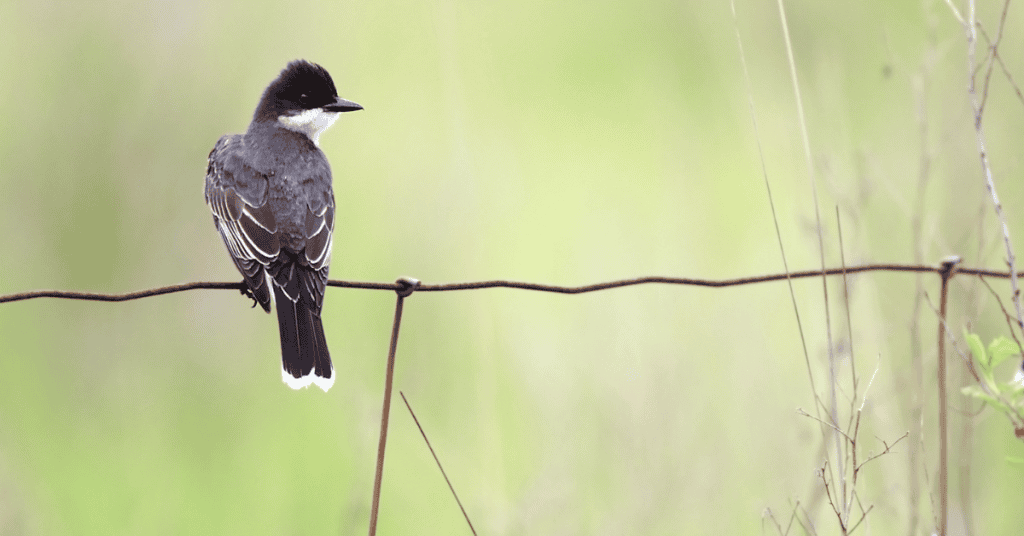
Eastern Kingbirds have a dark gray back, a darker head, and white underparts. Overall, they are pretty unique-looking with the black and white features. The clearest field mark is the white band across the end of the dark tail. Look for it when the bird turns or flies away.
Adults measure roughly 7½ to 9 inches long. Their relatively large heads and upright posture can help you spot them from a distance. Males and females have similar plumage, so color alone usually won’t tell you which you’re watching.
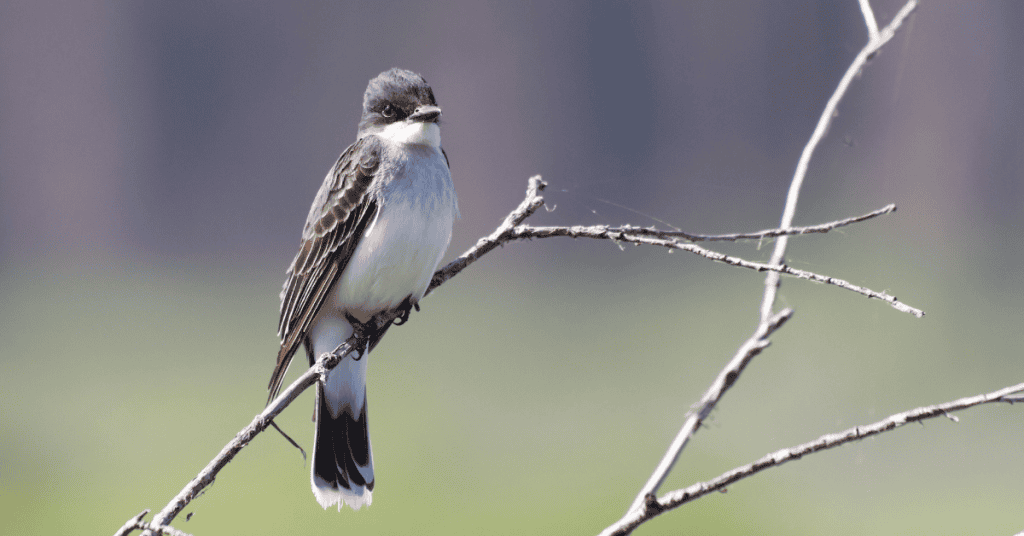
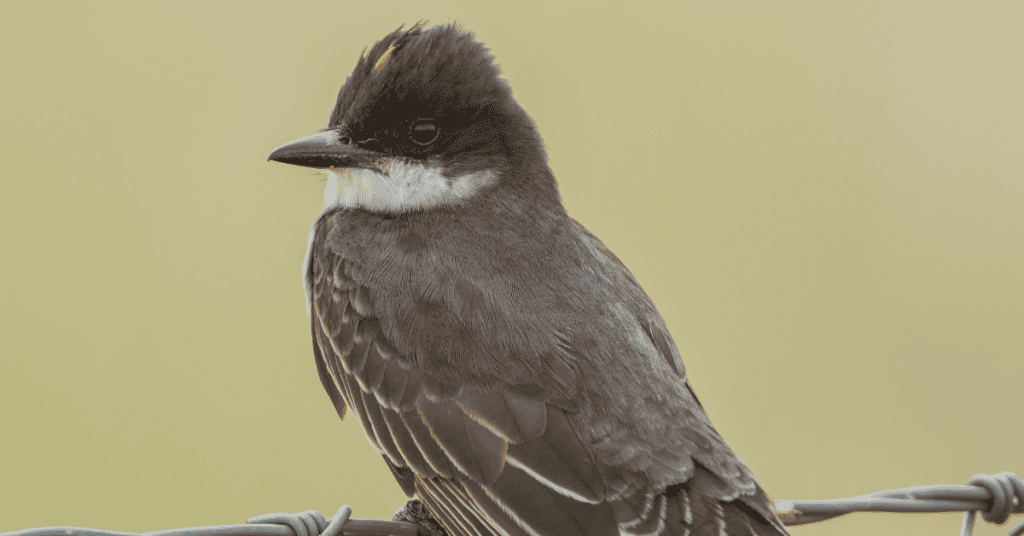
A small patch of yellow, orange, or red feathers is also hidden on the crown. Most of the time, the surrounding feathers cover it. During a threatening encounter, a kingbird may expose that patch while opening its mouth and diving at an intruder.
Habitat: Where Eastern Kingbirds Live
Look for Eastern Kingbirds in open areas with scattered trees, including fields, orchards, pond edges, and farmland. The main thing is that they need places to perch and enough open space to catch flying insects. And this is why many photograph them on a fence or wire.
Despite the name, their breeding range extends well west of the Mississippi River. These birds occur across much of the United States and southern Canada during the breeding season.
A bird on a fence post or utility wire may stay in view long enough for a good look. Watch where it goes after leaving its perch. It will often return to the same spot after catching an insect.
Food: What Do Eastern Kingbirds Eat?
During the breeding season, Eastern Kingbirds eat mostly insects. Their prey includes flies, beetles, grasshoppers, bees, and wasps. They watch from an exposed perch, then fly out to intercept a passing insect.
They may swallow small prey in flight. They often bring larger insects back and beat them against a perch before swallowing them whole. Kingbirds can also take food from vegetation, the ground, or the water’s surface.
Occasionally, they catch small frogs. Those receive similar treatment before being swallowed.
Another detail is easy to miss: both adults and nestlings regurgitate pellets containing insect exoskeletons. Owls aren’t the only birds leaving behind the parts of a meal they cannot digest.
Behavior: Why Do Kingbirds Chase Larger Birds?
A nesting kingbird may chase hawks, crows, or other animals that approach too closely. Its size doesn’t stop it from repeatedly diving at a potential threat.
The Tennessee Wildlife Resources Agency describes an observation in which a kingbird knocked a Blue Jay out of a tree. The jay took shelter beneath a bush to escape. Anyone who has watched a confident Blue Jay at a feeder can probably appreciate that scene.
These aggressive encounters do have a practical purpose. Because eggs and nestlings are vulnerable to predators, driving an intruder away helps protect them. The aggression can include a raised crown, an open bill, and repeated aerial attacks.
Nesting: Building the Nest and Feeding the Young
The female constructs a sturdy cup nest, often in a tree beside an open area or over water. Building takes about one to two weeks. Like many other birds they use coarser materials to form the outside. While, finer roots, plant down, and other soft materials line the interior.
A clutch usually contains three or four eggs. Both parents feed the nestlings, which typically make their first flights about 16 to 18 days after hatching.
A Nesting Encounter on Long Island
In July 2014, a birder writing for 10,000 Birds described watching a pair near Gabreski Airport on Long Island. Their nest stood beside a quiet road, and he observed them from his car across the street.
Over roughly half an hour, the adults repeatedly brought insects to their three nestlings. One photographed meal was a robber fly.
It’s the kind of scene worth slowing down for. Looking closely at food deliveries can reveal what the parents catch, how large the prey is, and how often they return.
Parental Care Continues After Fledging
Leaving the nest doesn’t mean a young kingbird can feed itself immediately. Parents continue supplying food for weeks afterward.
Cornell describes a total feeding period of about seven weeks. That extended care helps explain why Eastern Kingbirds generally raise only one brood in a breeding season.
What are their Calls and Dawn Singing Like?
Eastern Kingbird calls are sharp and buzzy, sometimes described as electrical. Males also perform a more elaborate dawn song.
Check out our YouTube video on the calls and sounds of Eastern Kingbirds.
A study of 87 males found that singing varied with social conditions. Birds with more neighbors tended to begin earlier and sing longer. The researchers also found relationships between singing behavior and the availability of fertile females.
They suggested that attracting females outside an existing pair bond may help explain the dawn performance. That remains an interpretation of the findings, rather than proof of why any individual bird is singing.
Migration: Traveling to South America
Eastern Kingbirds spend the nonbreeding season in South America. Their social behavior and diet change there: birds that defended breeding territories gather in flocks, and fruit becomes a major food source.
Tracking research has revealed some of their individual routes. In a 2021 study, researchers recovered geolocators from birds breeding in New York, Nebraska, and Oregon.
The tracked New York birds followed the Atlantic coast toward Florida during fall migration. Some crossed the Gulf of Mexico without stopping, while others stopped on islands. One bird used the Cayman Islands during one autumn journey and Cuba during another.
Some of the birds also moved between regions within South America before returning north. The sample was small, but it shows why migration is more complicated than a single arrow pointing south on a map.
A Connecticut Rescue: The Risk of Discarded Fishing Line
In 2019, nature writer Chris Bosak shared a rescue involving an Eastern Kingbird in Danbury, Connecticut. His twelve-year-old son, Will, had spotted the bird dangling from fishing line above the water and came home for help.
They reached it by canoe and freed the line wrapped around its wing. The frightened bird bit at Chris’s hand during the rescue, then flew into the woods when released.
Afterward, Chris noticed a nest about a foot above the tangled line. The hazard had been beside the bird’s nesting site.
Chris and Will also removed other abandoned fishing gear they could reach. Their experience shows how discarded line can remain dangerous long after someone stops fishing. A bird capable of chasing a hawk can still become trapped in a few strands.
Birdwatching with Eastern Kingbirds
Once you recognize the white tail tip, spend a few minutes following the bird’s movements. Notice its favorite perch, what it catches, and whether it eats there or carries food away. When I was taking a class in how to study animals behavior, we had to write all of this down in a log book. Even the mundane things, because this is how you start to see a pattern.
If you find a nesting pair, give them space and watch from a distance. The Long Island encounter shows how much a quiet observer can see without approaching the nest.
You don’t need to witness a hawk chase to enjoy watching kingbirds. A few hunting flights and food deliveries can give you plenty to notice.